International Trade Payment Methods: A B2B Guide
What are the main international trade payment methods?
International trade payment methods are the agreed ways an importer pays an exporter across borders. The five common options are cash in advance, letters of credit, documentary collections, open account, and consignment. Each shifts risk and cost differently between buyer and seller — and none of them is neutral.
Choosing the wrong one can tie up your cash, expose you to non-payment, or hand a deal to a competitor who offered friendlier terms. This guide explains each method, then gives you a side-by-side comparison and a checklist so you can match the right structure to each transaction.
Payment terms sit at the center of every cross-border deal, alongside your Incoterms 2020 rules — the ICC standard that allocates delivery cost and risk between buyer and seller — and your shipping plan. Get it wrong and even a profitable order can turn into a loss.
What are the five international trade payment methods?
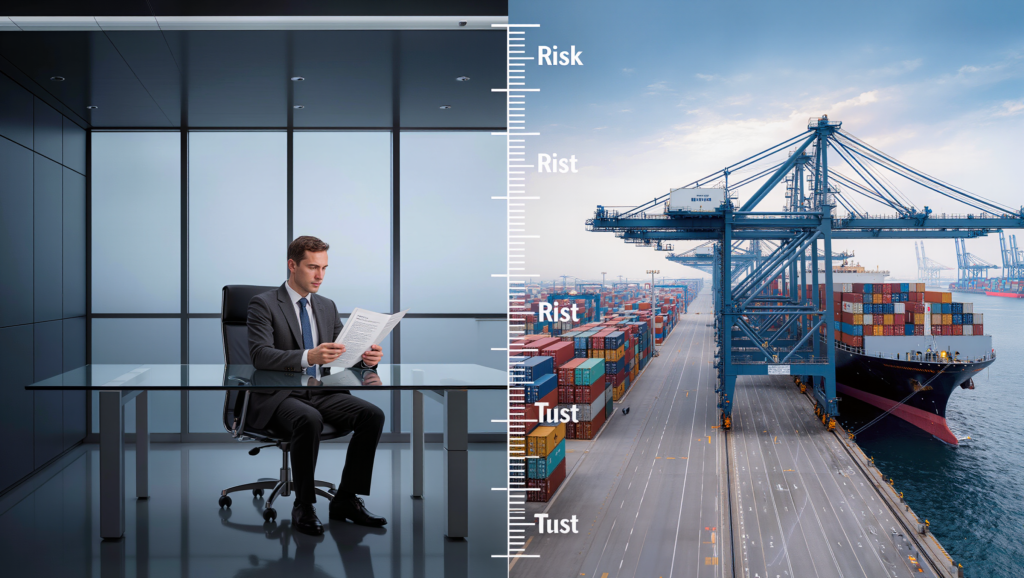
Think of these five options as a risk ladder. At one end, the exporter is fully protected; at the other, the importer is. The US government’s export portal, trade.gov, frames them the same way — as a spectrum from most secure for the seller to most secure for the buyer. (trade.gov — Methods of Payment)
1. Cash in advance
The buyer pays before goods ship. Payment usually moves by T/T (telegraphic transfer) — the standard bank-to-bank wire instruction used for most international payments — or, less often, by credit card for smaller orders.
- Best for the seller. Zero non-payment risk; funds arrive before any commitment.
- Hardest for the buyer. Your capital is tied up, and you rely entirely on the supplier to ship as promised.
Cash in advance is common for first orders with an unknown counterparty, custom-made goods, or small transaction values. Established buyers rightly push back on it, because it puts all the risk on their side.
2. Letter of credit (L/C)
A letter of credit is a bank’s written promise to pay the exporter once specific documents are presented, exactly as the credit requires. The importer’s bank (the issuing bank) substitutes its own creditworthiness for the buyer’s.
Letters of credit are governed worldwide by the ICC’s Uniform Customs and Practice for Documentary Credits, known as UCP 600. (ICC — UCP 600)
- Balanced protection. The seller gets a bank guarantee; the buyer knows payment releases only against compliant documents.
- Document-driven. Banks pay on documents, not on goods. A single discrepancy — a misspelled name, a shipment date that’s one day past the deadline — can delay or block payment.
L/Cs suit larger transactions, new trading relationships, or markets with higher political and credit risk. They cost more (bank fees on both sides) and the paperwork has to be exact, but they’re the workhorse of secure trade finance for a reason.
In practice, a discrepancy rate of around 70–80% on first presentation is common across global trade. That means the majority of document sets are returned for correction at least once before payment is released. (ICC Trade Register 2023)
A first-time electronics importer sourcing from a new supplier should default to an L/C — a bank fee of $500–$1,500 is cheap insurance on a $50,000 order.
3. Documentary collection (D/C)
In a documentary collection, the exporter’s bank forwards shipping and title documents to the importer’s bank. The bank then releases those documents to the buyer only against payment (documents against payment, D/P) or against a signed promise to pay later (documents against acceptance, D/A).
These transactions follow the ICC’s Uniform Rules for Collections (URC 522). (ICC — URC 522)
- Cheaper than an L/C. Banks act as intermediaries but do not guarantee payment.
- Less protection. If the buyer refuses the documents, the seller is left with goods already at a foreign port.
Documentary collections work well when buyer and seller trust each other reasonably but still want banks to control the release of title.
4. Open account
The exporter ships and delivers the goods, then invoices the buyer, who pays within an agreed period — commonly 30, 60, or 90 days after delivery.
- Best for the buyer. Goods arrive before any money leaves; cash flow improves.
- Riskiest for the seller. You extend credit and carry the non-payment exposure.
Open account terms are standard between established partners and often expected in competitive markets — if your rivals offer 60-day terms and you’re asking for payment upfront, you’ll likely lose the sale. Exporters who offer open account typically protect themselves with export credit insurance or trade finance rather than refusing the terms outright.
5. Consignment
Consignment is a variation of open account: the exporter ships goods to a foreign distributor but is paid only after the distributor sells them to the end customer. Ownership — and risk — stays with the exporter until sale.
It can open new markets and reduce a distributor’s upfront cost, but the exporter finances the entire inventory cycle and depends on a partner it may not control. Use it only with trusted distributors and, ideally, insurance.
How do the five payment methods compare by risk and cost?
The table below summarizes how the five international trade payment methods distribute risk. “Risk” here means exposure to the other party not performing.
| Method | Risk to exporter | Risk to importer | Relative cost | Typical use case |
|---|---|---|---|---|
| Cash in advance | Lowest | Highest | Low | First orders, custom goods, unknown buyer |
| Letter of credit | Low | Low–moderate | High (bank fees) | Large deals, new relationships, higher-risk markets |
| Documentary collection | Moderate | Moderate | Moderate | Reasonable trust, banks control documents |
| Open account | High | Lowest | Low | Established partners, competitive markets |
| Consignment | Highest | Lowest | Low | Trusted distributors, market entry |
It’s a mirror image: what protects the seller exposes the buyer, and vice versa. The “right” method is the one both sides can live with, given the trust level and value of that specific deal.
How do you choose the right international trade payment method?
No single international trade payment method works for every deal. Run each new transaction through this checklist before you agree on terms:
- How well do you know the counterparty? A first deal justifies more security (cash in advance or L/C); a decade-long partner may earn open account.
- What is the transaction value? High-value orders warrant the cost of a letter of credit; small orders rarely do.
- What is the country and political risk? Unstable markets push you toward bank-backed instruments.
- How competitive is your market? If rivals offer open account, insisting on cash in advance can cost you the sale.
- What is your cash-flow tolerance? Importers paying in advance need working capital; exporters offering open account finance the gap.
- Can you insure or finance the risk? Export credit insurance and trade finance let exporters offer softer terms safely.
- Do your Incoterms and payment terms align? Payment timing should match when risk and cost transfer under your chosen Incoterm.
There’s no universally best method — only the best fit for a given deal, counterparty, and market.
What tools and services support international trade payments?
Executing and securing these five payment methods rarely happens with a bank transfer alone. Depending on the method chosen, businesses commonly rely on a combination of:
- Trade finance facilities. Bank-provided pre-shipment or post-shipment financing that lets an exporter offer open account or consignment terms without carrying the full cash-flow gap alone.
- Bank guarantees and standby letters of credit. A fallback layered onto open account or documentary collection deals for parties who want a lighter method’s flexibility with some of an L/C’s protection.
- Trade credit insurance. Insures an exporter against buyer non-payment on open account terms — one of the more common ways businesses make open account viable with newer counterparties.
- Escrow and payment intermediary services. A neutral third party holds funds until agreed shipment or delivery conditions are met, used as a lighter-weight alternative to a full letter of credit for mid-sized deals.
Which combination makes sense depends on the deal size, the destination market’s risk profile, and how well you know the counterparty — the same factors that drive the choice of payment method itself.
Common mistakes to avoid
- Treating payment terms as an afterthought. Negotiate them alongside price and Incoterms, not after.
- Ignoring L/C document discipline. Because banks pay on documents, sloppy paperwork is the top cause of delayed or refused payment. Check every field against the credit.
- Offering open account with no protection. Extending credit without insurance or a credit check invites bad debt.
- Using one method for every deal. Reassess the right structure for each counterparty and transaction.
- Confusing Incoterms with payment terms. Incoterms allocate delivery risk; they do not determine when or how you get paid. Set both deliberately.
Key Takeaways
- Use cash in advance or an L/C for first-time buyers and high-risk markets; reserve open account for proven partners.
- Letters of credit are document-driven — a single discrepancy can block payment regardless of goods quality.
- Open account is the competitive norm in many markets; protect it with export credit insurance, not blanket refusal.
- Documentary collections cost less than L/Cs but offer no bank guarantee that the buyer will pay.
- Align payment terms and Incoterms 2020 rules on every deal — each addresses a different risk.
Frequently Asked Questions
Q: What is the safest international trade payment method for exporters?
Cash in advance is the safest option for exporters because the buyer pays before goods ship, removing the exporter’s non-payment exposure. For larger transactions where buyers resist prepayment, an irrevocable letter of credit confirmed by a reputable bank is the next-strongest protection available.
Q: What is the difference between a letter of credit and a documentary collection?
Both use banks to control the release of shipping documents, but the key difference is commitment. In a letter of credit, the issuing bank guarantees payment once compliant documents are presented. In a documentary collection, the bank acts only as an intermediary — it forwards documents but does not guarantee the buyer will pay or accept them.
Q: When should I use open account terms in international trade?
Open account is appropriate when you have an established, trusted relationship with the buyer and operate in a competitive market where rivals already offer deferred payment. Exporters who extend open account terms should protect themselves with export credit insurance or trade finance rather than refusing the terms and losing the sale.
Q: What is the difference between D/P and D/A in documentary collections?
In documents against payment (D/P), the importer’s bank releases shipping documents only once the buyer pays in full. In documents against acceptance (D/A), the bank releases documents against the buyer’s signed promise — a trade acceptance — to pay on a specified future date, effectively extending credit to the buyer.
Q: Do Incoterms determine when and how I get paid?
No. Incoterms 2020 rules govern where delivery cost and risk transfer from seller to buyer — they do not dictate when payment is made or what payment method is used. You must set both your Incoterm and your payment terms separately and ensure they are consistent with each other in every contract.
Q: How many payment methods are there in international trade?
Five main payment methods cover the large majority of international trade transactions: cash in advance, letter of credit, documentary collection, open account, and consignment. Most deals sit somewhere between the two extremes — cash in advance protects the seller fully, consignment protects the buyer fully — with the other three methods occupying the middle ground.
Final Thoughts
International trade payment methods are a balance of trust, risk, and cost — and the right choice shifts with every counterparty and market. Know the five options well enough to reach for the right one on each deal, and you’ll protect your margin without pricing yourself out of business.
Arsham Trade helps importers and exporters structure secure, workable deals end to end — from sourcing and logistics to customs clearance. If you want help choosing the right payment terms for your next transaction, contact the Arsham Trade team or explore our international trading services.
Sources
- U.S. Department of Commerce, International Trade Administration — Methods of Payment: https://www.trade.gov/methods-payment
- International Chamber of Commerce — Uniform Customs and Practice for Documentary Credits (UCP 600): https://iccwbo.org/business-solutions/uniform-customs-practice-documentary-credits-ucp-600/
- International Chamber of Commerce — Uniform Rules for Collections (URC 522): https://iccwbo.org/business-solutions/uniform-rules-collections-urc-522/
- International Chamber of Commerce — ICC Trade Register 2023: https://iccwbo.org/news-publications/icc-trade-register/