Importing Bathroom Fixtures and Sanitary Ware: A Buyer’s Guide
Bathroom fixtures are some of the least forgiving goods to import. A washbasin or a jacuzzi shell is heavy, breaks if it’s dropped the wrong way, and takes up container space out of proportion to its price. Get the sourcing or the freight plan wrong and the margin on the whole shipment disappears into breakage claims and demurrage fees. This guide walks through the parts of the process that are specific to sanitary ware: supplier vetting, packaging, freight class, duties, and the landed cost math that tells you whether a deal is actually worth doing.
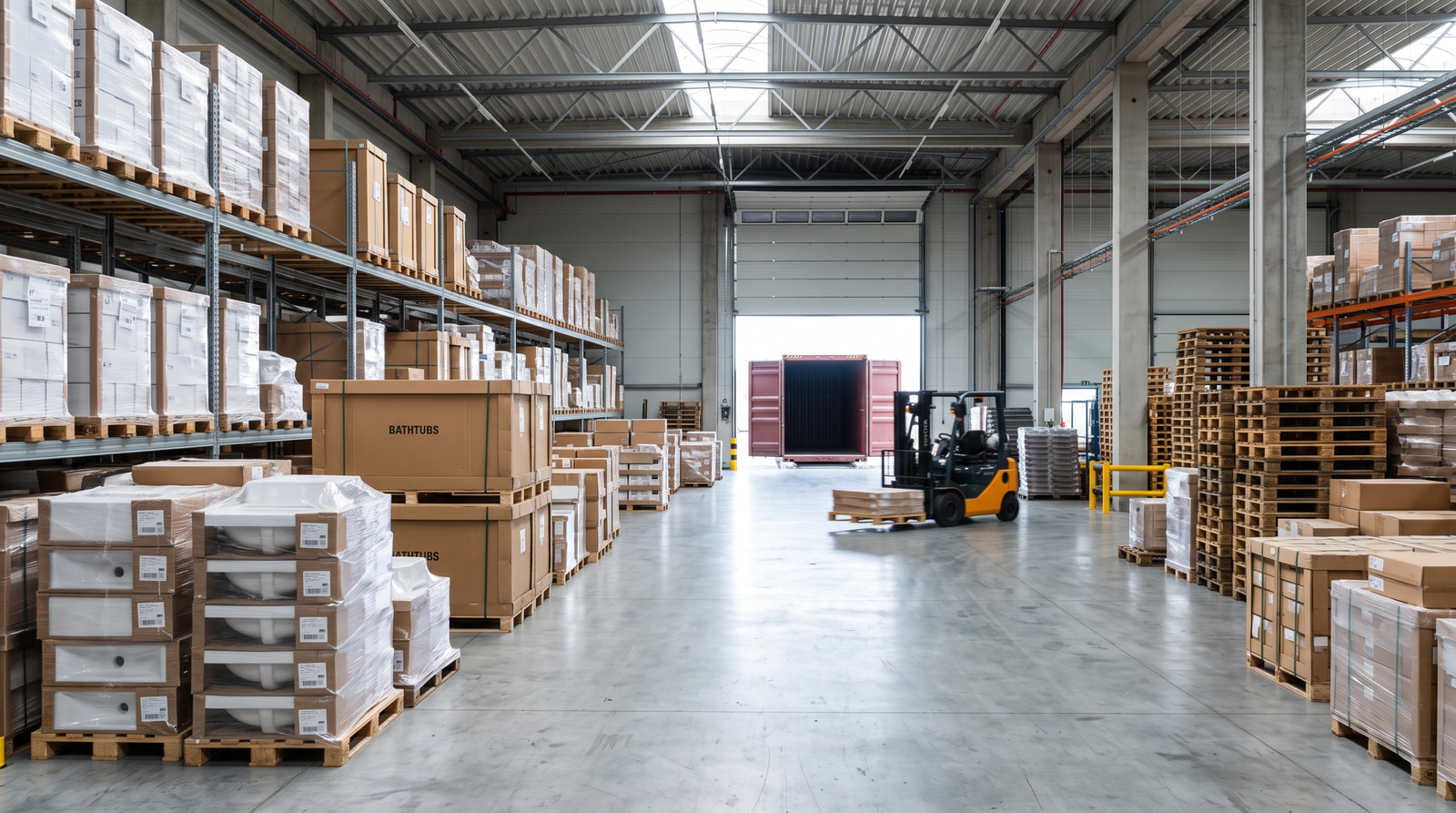
Why sanitary ware behaves differently from other imports
Most import guides treat cargo as one category. Bathroom fixtures don’t fit that mold, for three reasons.
Breakage risk is built into the product itself. Ceramic basins and toilets are fired clay: rigid under vertical load, but they shatter under a sideways knock. A phone case that arrives dented is still sellable. A cracked basin is scrap.
Cube-to-weight ratio is poor. A whirlpool bathtub or a jacuzzi shell takes up a large volume of the container relative to what it weighs and what it sells for. Ocean freight is priced by whichever of weight or volume is higher, so these items are usually volume-rated, which changes how supplier quotes should be compared (more on that below).
And the category carries real electrical-safety and plumbing-code expectations before it ever reaches a shelf. Pump units for jacuzzis and whirlpool baths are certified separately by market, and a unit built for one region isn’t automatically compliant in another, a compliance step first-time importers often skip.
Vetting a sanitary ware supplier
The general checklist in our guide to finding reliable suppliers still applies: trade references, a paid sample order, a factory audit if the order size justifies it. Two things matter specifically for this category.
Ask for the glaze and firing specification, not just a photo. Ceramic quality varies more than a product photo shows. A supplier who can quote firing temperature, water absorption rate, and glaze thickness is manufacturing to a documented process. One who answers “premium quality guaranteed” and nothing else is not.
For anything with a pump, motor, or electronic control, request a drop-test or transit simulation report. Jacuzzis and whirlpool bathtubs fall in this group, and they fail in ways a basin doesn’t: seals loosen, wiring shifts, control panels crack internally with no visible damage on the outside. A supplier who has already run vibration or drop testing on the packed unit has caught problems you’d otherwise find the hard way, after the container is unloaded.
Packaging is the make-or-break variable
For most product categories, packaging is a line item. For sanitary ware, it’s the difference between a profitable shipment and a write-off.
Look for these specifics in a supplier’s packing method rather than accepting “export packaging” as an answer:
- Foam or molded pulp corner protection on ceramic pieces, not just cardboard.
- Wooden crating for bathtubs, jacuzzis, and anything over roughly 40 kg. Cardboard alone doesn’t survive forklift handling at transshipment ports.
- Palletized, shrink-wrapped units rather than loose cartons, so the load can’t shift during ocean transit.
- Fragile and this-side-up markings in the destination country’s language, not only English, since the customs and warehouse staff on the receiving end are the ones who need to read them.
Ask what percentage of shipments arrive with breakage claims. A supplier who tracks that number and can quote it is managing the risk. One who has never measured it is asking the importer to find out the hard way.
Freight class and container planning
Sanitary ware is almost always volume-rated, meaning dimensional weight beats actual weight, so the number driving the freight bill is cubic meters, not kilograms. Get quotes in cost per CBM, not cost per kilogram, or the comparison between suppliers won’t reflect what actually shows up on the invoice.
Loading order matters too. Heavier, sturdier items, crated bathtubs and floor-mounted units, go on the container floor; lighter ceramic pieces go higher, secured so they can’t shift. A freight forwarder experienced with this category will ask about loading order before booking, not after the container is already loaded. If they don’t ask, that’s worth noting when evaluating them against the criteria in our guide to what makes a good logistics company.
Duties, certification, and the landed cost math
Two sub-categories carry different duty and certification treatment, worth separating before quoting a customer:
Duty exposure varies by sub-category and destination market, more than a generic import guide usually credits. For the EU specifically, ceramic tableware and kitchenware from China carry a 79% anti-dumping duty under a February 2026 EU ruling, and ceramic tiles from China separately carry anti-dumping duties in the 13.9-69.7% range (source: EU Implementing Regulation 2026/274; Cerame-Unie). Plain bathroom sanitaryware, basins, toilets, taps, showers, acrylic baths, currently carries no EU anti-dumping or countervailing measures. That figure is EU-specific; this guide has no equivalent confirmed figure for other markets, so check the current tariff schedule and any anti-dumping measures for your own destination country and exact product code before pricing a deal, not after.
Electrical and pump-driven units (jacuzzis, whirlpool baths) need certification that’s specific to the destination market. In the US and Canada, whirlpool bathtubs are expected to meet ASME A112.19.7/CSA B45.10 and carry UL 1795 listing, with pumps evaluated separately under UL 1081 or CSA C22.2 No. 108 (source: UpCodes; UL). European markets require CE marking instead; a unit certified for one region isn’t automatically compliant in another, so confirm which certification the destination market actually requires before ordering, not after the container has shipped. Missing this paperwork is one of the more common causes of customs holds on this category.
Landed cost is what actually tells an importer whether a deal works, and it’s more than product price plus freight:
Landed cost = Product cost
            + Freight (usually CBM-based for this category)
            + Insurance
            + Duties and tariffs
            + Customs clearance and handling fees
            + Inland transport to warehouse
            + A realistic breakage/loss allowance, based on the supplier's
              packaging record and the route's transshipment history
That last line is the one general import guides tend to skip, and it’s the one that matters most here. If a supplier’s historical breakage rate on a given route is 3%, price that in before quoting the customer, not after a damaged pallet turns up at the warehouse.
Pre-shipment checklist
Before confirming a purchase order for bathroom fixtures or sanitary ware:
- Supplier trade references checked and a paid sample order received and inspected.
- Glaze and firing specification (ceramic) or electrical certification (pump units) obtained in writing.
- Packaging method confirmed against the specifics above, not accepted as “export packaging.”
- Freight quoted in cost per CBM with loading order agreed with the forwarder.
- Duty classification and any anti-dumping exposure checked for the destination market.
- Landed cost calculated with a realistic breakage allowance included.
Sanitary ware rewards importers who treat packaging and freight class as sourcing decisions, not afterthoughts. The margin sits in the details a generic import checklist skips over.
Arsham Trade coordinates sourcing, freight, and customs support for import businesses. This guide reflects general practice in the sanitary ware and bathroom fixtures trade; check it against the specific tariff and certification rules of the destination market before acting on it. For related reading, see our guides on finding reliable suppliers and qualities of a reliable logistics company.